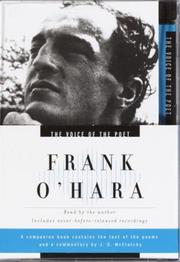
Francis Russell O'Hara was an American poet who, along with John Ashbery, James Schuyler, Barbara Guest and Kenneth Koch, was a key member of the New York School of poetry.
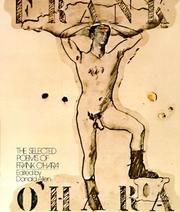
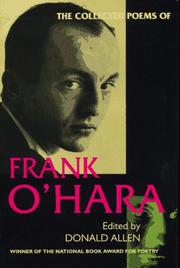
O'Hara's poetry is generally autobiographical, much of it based on observations on what is happening to him in the moment. Donald Allen says in his introduction to The Collected Poems of Frank O’Hara, “That Frank O’Hara tended to think of his poems as a record of his life is apparent in much of his work.” [2] O'Hara discusses this aspect of his poetry in a statement for Donald Allen's New American Poetry: “What is happening to me, allowing for lies and exaggerations which I try to avoid, goes into my poems. I don’t think my experiences are clarified or made beautiful for myself or anyone else, they are just there in whatever form I can find them.” He goes on to say, "My formal 'stance' is found at the crossroads where what I know and can't get meets what is left of that I know and can bear without hatred." He then says, "It may be that poetry makes life's nebulous events tangible to me and restores their detail; or conversely that poetry brings forth the intangible quality of incidents which are all too concrete and circumstantial. Or each on specific occasions, or both all the time."[3]
Among his friends, O'Hara was known to treat poetry dismissively, as something to be done only in the moment. John Ashbery claims he witnessed O'Hara “Dashing the poems off at odd moments – in his office at the Museum of Modern Art, in the street at lunchtime or even in a room full of people – he would then put them away in drawers and cartons and half forget them.” [2]
In 1959, he wrote a mock manifesto (originally published in Yugen in 1961) called "Personism: A Manifesto." In it, he explains his position on formal structure: "I don't ... like rhythm, assonance, all that stuff. You just go on your nerve. If someone's chasing you down the street with a knife you just run, you don't turn around and shout, 'Give it up! I was a track star for Mineola Prep.'" He also says, in response to an academic over-emphasis on form, "As for measure and other technical apparatus, that's just common sense: if you're going to buy a pair of pants you want them to be tight enough so everyone will want to go to bed with you. There's nothing metaphysical about it." He claims that on August 27, 1959, while talking to LeRoi Jones, he founded a movement called Personism which may be "the death of literature as we know it." He says, "It does not have to do with personality or intimacy, far from it! But to give you a vague idea, one of its minimal aspects is to address itself to one person (other than the poet himself), thus evoking overtones of love without destroying love's life-giving vulgarity, and sustaining the poet's feelings toward the poem while preventing love from distracting him into feeling about the person."[4]
His poetry shows the influence of Abstract Expressionism, Surrealism, Russian poetry, and poets associated with French Symbolism. Ashbery says, “The poetry that meant the most to him when he began writing was either French – Rimbaud, Mallarmé, the Surrealists: poets who speak the language of every day into the reader’s dream – or Russian – Pasternak and especially Mayakovsky, for whom he picked up what James Schuyler has called the ‘intimate yell.’”[2]
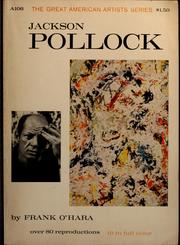
As part of the New York School of poetry, O'Hara to some degree encapsulated the compositional philosophy of New York School painters.[5][6] Ashbery says, “Frank O’Hara’s concept of the poem as the chronicle of the creative act that produces it was strengthened by his intimate experience of Pollock’s, Kline’s, and de Kooning’s great paintings of the late 40s and early 50s and of the imaginative realism of painters like Jane Freilicher and Larry Rivers.”[2]
This interaction between poet and painter is most evident in the poem 'Why I am Not A Painter' in which O'Hara parallels the process of writing a poem called 'Oranges' with a description of his friend Mike Goldberg's creation of a painting entitled 'Sardines'. Both described works contain no internal reference to their title.