Author

Mary Robinson

born 1758 72 known books newest first

Robinson was born in Bristol, England to Nicholas Darby, a naval captain, and his wife Hester (née Vanacott). She was baptised 'Polle(y)'. In her memoirs, Robinson gives her birth in 1758 but the year 1757 seems more likely according to recently published research. Her father deserted her mother and took on a mistress when Robinson was still a child. Darby died in the Russian naval service in 1785. Robinson, who at one point attended a school run by the social reformer Hannah More, came to the attention of actor David Garrick.

Hester Darby encouraged her daughter to accept the proposal of an articled clerk, Thomas Robinson, who claimed to have an inheritance. Mary was against this idea; however, after being stricken ill, and watching him take care of her and her younger brother, she felt that she owed him, and she did not want to disappoint her mother. After the early marriage, Robinson discovered that her husband did not have an inheritance. He continued to live an elaborate lifestyle, however, and had multiple affairs that he made no effort to hide. Subsequently, Mary supported their family. After her husband squandered their money, the couple fled to Talgarth, Breconshire (where Robinson's only daughter, Mary Elizabeth, was born in November). Eventually her husband was imprisoned for debt in the Fleet Prison where she lived with him for many months. While it was common for the wives of prisoners to live with their husbands while indebted, children were usually sent to live with relatives to keep them away from the dangers of prison. However, Robinson was deeply devoted to her daughter Maria, and when her husband was imprisoned, Robinson brought the 6-month-old baby with her. It was in the Fleet Prison that Robinson’s literary career really began, as she found that she could publish poetry to earn money, and to give her an escape from the harsh reality that had become her life. During this time, Mary Robinson found a patron in Georgiana Cavendish, Duchess of Devonshire, who sponsored the publication of Robinson's first volume of poems, Captivity.

After her husband obtained his release from prison, Robinson decided to return to the theatre. She launched her acting career and took to the stage, playing Juliet, at Drury Lane Theatre in December 1776. Robinson was best known for her facility with the 'breeches parts', her performances as Viola in William Shakespeare'sTwelfth Night and Rosalind in As You Like It won her extensive praise. But she gained popularity with playing in Florizel and Perdita, an adaptation of Shakespeare, with the role of Perdita in 1779. It was during this performance that she attracted the notice of the young Prince of Wales, later King George IV of the United Kingdom. He offered her twenty thousand pounds to become his mistress.

With her new social prominence, Robinson became a trend-setter in London, introducing a loose, flowing muslin style of gown based upon Grecian statuary that became known as the Perdita. It took Robinson a considerable amount of time to decide to leave her husband for the Prince, as she did not want to be seen by the public as that type of woman. Throughout much of her life she struggled to live in the public eye and also to stay true to the values in which she believed. She eventually gave in to her desires to be with a man whom she thought would treat her better than Mr. Robinson. However, the Prince ended the affair in 1781, refusing to pay the promised sum. "Perdita" Robinson was left to support herself through an annuity promised by the Crown (but rarely paid), in return for some letters written by the Prince, and through her writings.

Mary Robinson, who now lived separately from her husband, went on to have several love affairs. Her relationship with Tarleton began on a bet, but lasted 15 years. They had no children, although Robinson had a miscarriage. However, in the end, Tarleton married Susan Bertie, an heiress and an illegitimate daughter of the young 4th Duke of Ancaster, and niece of his sisters Lady Willoughby de Eresby and Lady Cholmondeley. In 1783, Robinson suffered a mysterious illness that left her partially paralysed. Biographer Paula Byrne speculates that a streptococcal infection resulting from a miscarriage led to a severe rheumatic fever that left her disabled for the rest of her life.

From the late 1780s, Robinson became distinguished for her poetry and was called "the English Sappho". In addition to poems, she wrote eight novels, three plays, feminist treatises, and an autobiographical manuscript that was incomplete at the time of her death. Like her contemporary Mary Wollstonecraft, she championed the rights of women and was an ardent supporter of the French Revolution. She died in poverty at Englefield Cottage, Englefield Green, Surrey, 26 December 1800, aged 44, having survived several years of ill health, and was survived by her daughter, Maria Elizabeth (1774-1818), who was also a published novelist. Administration of her estate was granted to her husband Thomas Robinson from whom she had long been separated and who in 1803 inherited a substantial estate from his half-brother William. One of Robinson’s dying wishes was to see the rest of her works published. She tasked her daughter, Maria Robinson, with publishing most of these works. She also placed her Memoirs in the care of her daughter, insisting that she publish the work. Maria Robinson published Memoirs just a few months later.
Books

OpenLibrary works by this author.

72 books
Mary Robinson

Mary Robinson

2000 Mary Robinson, Mary Robinson, and Judith Pascoe
Letter to the women of England on the injustice of mental subordination

Letter to the women of England on the injustice of mental subordination

1998
Sappho and Phaon

Sappho and Phaon

1995
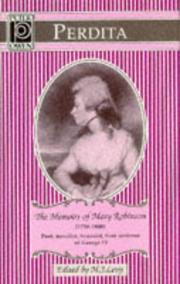
Perdita

Perdita

1994
Poems

Poems

1994
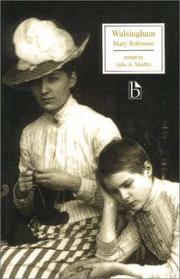
Walsingham, or, The pupil of nature

Walsingham, or, The pupil of nature

1992
The Sicilian lover

The Sicilian lover

1956
A letter to the women of England

A letter to the women of England

1900
Memoirs of Mary Robinson

Memoirs of Mary Robinson

1895
Vancenza

Vancenza

1810
Poetical works

Poetical works

1806
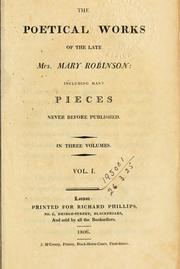
The poetical works of the late Mrs. Mary Robinson

The poetical works of the late Mrs. Mary Robinson

1806
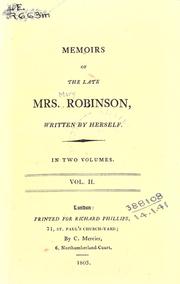
Memoirs of the late Mrs. Robinson...

Memoirs of the late Mrs. Robinson, written by herself

1802
Memoirs of the late Mrs. Robinson

Memoirs of the late Mrs. Robinson

1801
Lyrical tales

Lyrical tales

1800
The mistletoe

The mistletoe

1800
The mistletoe. --- A Christmas ta...

The mistletoe. --- A Christmas tale. By Laura Maria

1800
The false friend

The false friend

1799
The natural daughter. With portra...

The natural daughter. With portraits of the Leadenhead family. A novel. By Mrs. Robinson, ... In two volumes ..

1799
Walsingham

Walsingham

1797
Angelina

Angelina

1796
Angelina; a novel, ... By Mrs. Ma...

Angelina; a novel, ... By Mrs. Mary Robinson, ..

1796
Hubert de Sevrac

Hubert de Sevrac

1796
The Sicilian lover. A tragedy

The Sicilian lover. A tragedy

1796
Poems, by Mrs. Mary Robinson

Poems, by Mrs. Mary Robinson

1795
The widow, or a picture of modern...

The widow, or a picture of modern times

1794
Monody to the memory of the late ...

Monody to the memory of the late Queen of France. By Mrs. Mary Robinson

1793
Ode to the harp of the late accom...

Ode to the harp of the late accomplished and amiable Louisa Hanway

1793
Sight, the cavern of woe, and sol...

Sight, the cavern of woe, and solitude

1793
Monody to the memory of Sir Joshu...

Monody to the memory of Sir Joshua Reynolds, late President of the Royal Academy, ... By Mrs. Mary Robinson

1792
Vancenza; or, the dangers of cred...

Vancenza; or, the dangers of credulity

1792
Poems by Mrs. M. Robinson

Poems by Mrs. M. Robinson

1791
Ainsi va le monde

Ainsi va le monde

1790
The songs, choruses, etc. ... in ...

The songs, choruses, etc. ... in The lucky escape

1778
The songs, chorusses, &c. in The ...

The songs, chorusses, &c. in The lucky escape

1778
Captivity

Captivity

1777
Poems by Mrs. Robinson

Poems by Mrs. Robinson

1775
Ainsi va le monde, a poem

Ainsi va le monde, a poem

Year unknown
D'Harcourt, ou L'héritier supposé

D'Harcourt, ou L'héritier supposé

Year unknown
Elegiac verses to a young lady

Elegiac verses to a young lady

Year unknown [Favard de Langlade, Guillaume Jean baron and Mary Robinson
Elegiac verses to a young lady on...

Elegiac verses to a young lady on the death of her brother

Year unknown
Hubert de Sevrac

Hubert de Sevrac

Year unknown
Impartial reflections on the pres...

Impartial reflections on the present situation of the Queen of France, 1791

Year unknown
Letters from Perdita to a certain...

Letters from Perdita to a certain Israelite

Year unknown H. R. and Mary Robinson
Letter to the women of England

Letter to the women of England

Year unknown
Lyrical tales

Lyrical tales

Year unknown
Lyrical tales

Lyrical tales

Year unknown
Lyrical tales

Lyrical tales

Year unknown
Memoirs

Memoirs

Year unknown
Memoirs of Mary Robinson, "Perdita"

Memoirs of Mary Robinson, "Perdita"

Year unknown
Memoirs of the late Mrs. Robinson

Memoirs of the late Mrs. Robinson

Year unknown
Memoirs of the late Mrs. Robinson

Memoirs of the late Mrs. Robinson

Year unknown
Memoirs of the late Mrs. Robinson...

Memoirs of the late Mrs. Robinson, written by herself

Year unknown Mary Robinson and Travis, Elizabeth (Producer)
Monody to the memory of the late ...

Monody to the memory of the late Queen of France

Year unknown
Mrs. Mary Robinson

Mrs. Mary Robinson

Year unknown
Poems

Poems

Year unknown
Sappho and Phaon

Sappho and Phaon

Year unknown
Sappho and Phaon, 1796

Sappho and Phaon, 1796

Year unknown
Sight

Sight

Year unknown
The natural daughter

The natural daughter

Year unknown
The Norton Anthology of English Literature --Seventh Edition -- Volume 2A

The Norton Anthology of English Literature --Seventh Edition -- Volume 2A

Year unknown M. H. Abrams, Anna Laetitia Barbauld, Charlotte Smith, William Blake, Mary Robinson, Robert Burns, Mary Wollstonecraft, Joanna Baillie, William Wordsworth, Dorothy Wordsworth, Sir Walter Scott, Samuel Taylor Coleridge, Walter Savage Landor, Charles Lamb, William Hazlitt, Thomas Moore, Thomas De Quincey, Lord Byron, Percy Bysshe Shelley, Clare, John, Felicia Dorothea Browne Hemans, John Keats, Mary Shelley, and L. E. L.
The poetical works of the late Mr...

The poetical works of the late Mrs. Mary Robinson

Year unknown
The poetical works of the late Mr...

The poetical works of the late Mrs. Mary Robinson, 1824

Year unknown
The Sicilian lover

The Sicilian lover

Year unknown
The widow

The widow

Year unknown
Thoughts on the condition of wome...

Thoughts on the condition of women, 1799

Year unknown
Vancenza

Vancenza

Year unknown
Vancenza; or, The dangers of cred...

Vancenza; or, The dangers of credulity

Year unknown
Vancenza; or, The dangers of cred...

Vancenza; or, The dangers of credulity

Year unknown
Walsingham

Walsingham

Year unknown
Walsingham, oder, Das Naturkind

Walsingham, oder, Das Naturkind

Year unknown
Walsingham, or, The pupil of nature

Walsingham, or, The pupil of nature

Year unknown

Fetched from OpenLibrary. Some translations may appear as separate works.