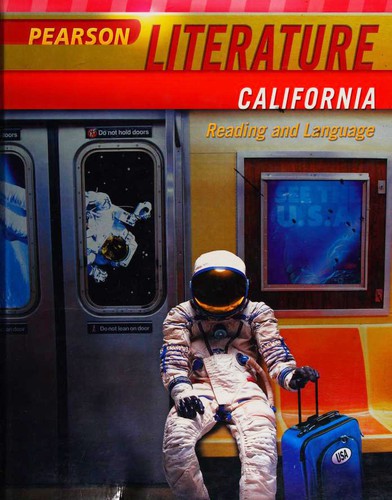
Pearson Literature--California--Reading and Language
Book

Pearson Literature--California--Reading and Language

by Grant P. Wiggins, Diane Ackerman, Brian W. Aldiss, Rudolfo A. Anaya, Maya Angelou, Susan B. Anthony, Brent K. Ashabranner, Isaac Asimov, Toni Cade Bambara, Stephen Vincent Benét, Cherie Bennett, Elizabeth Bishop, David Bottoms, Ray Bradbury, Joseph Bruchac, Lan Samantha Chang, Антон Павлович Чехов, Judith Ortiz Cofer, Stephen Crane, Davy Crockett, E. E. Cummings, Mary C. Curtis, Walter De la Mare, Emily Dickinson, Annie Dillard, Arthur Conan Doyle, Paul Laurence Dunbar, Erdoes, Richard, Eleanor Farjeon, Anne Frank, Russell Freedman, Robert Froman, Robert Frost, Lionel G. Garcia, Richard Garcia, Miep Gies, Nikki Giovanni, Alison Leslie Gold, Frances Goodrich, Robert Graves, Albert Hackett, Robert Hayden, O. Henry, Karen Hesse, Patricia Hubbell, Langston Hughes, Zora Neale Hurston, Shirley Jackson, Gish Jen, Georgia Douglas Camp Johnson, Daniel Keyes, Martin Luther King Jr., Emma Lazarus, Amy Ling, Jack London, Henry Wadsworth Longfellow, Robert MacNeil, Fredrick McKissack, Patricia McKissack, Eve Merriam, Andrew Mishkin, N. Scott Momaday, Pat Mora, Saki, Walter Dean Myers, Lensey Namioka, Pablo Neruda, Anaïs Nin, Naomi Shihab Nye, Alfonso Ortiz, Gary Paulsen, Ann Lane Petry, Edgar Allan Poe, William, Sydney Porter, Colin L. Powell, Wendy Rose, Ricardo Sanchez, Carl Sandburg, Juan A. Sedillo, William Shakespeare, Neil Simon, John Steinbeck, Jesse Stuart, Alfred Lord Tennyson, Jackie Torrence, Mark Twain, Yoshiko Uchida, John Updike, Alice Walker, Bailey White, Walt Whitman, Jacqueline Woodson

No ratings yet

Description

Meeting California Standards for Reading/Language Arts, set helps teachers build readers through motivating and engaging literature, scientifically research-based instruction, and a wealth of reliable teaching tools. The program takes the guesswork out of differentiating instruction with a strong emphasis on ongoing progress-monitoring and an explicit plan to help with managing small groups of students. Items for middle school help students grasp the power and beauty that lies within the written word, while the program's research-based reading approach ensures that no child is left behind. Starts with concepts such as realism and fantasy, main idea and details, sequence, classify and categorize, draw conclusions, and literary elements and progresses through generalize, graphic sources, compare and contrast, author's viewpoint/bias to forms of literature, such as fiction and non-fiction, poetry and drama and themes in types of literatures